
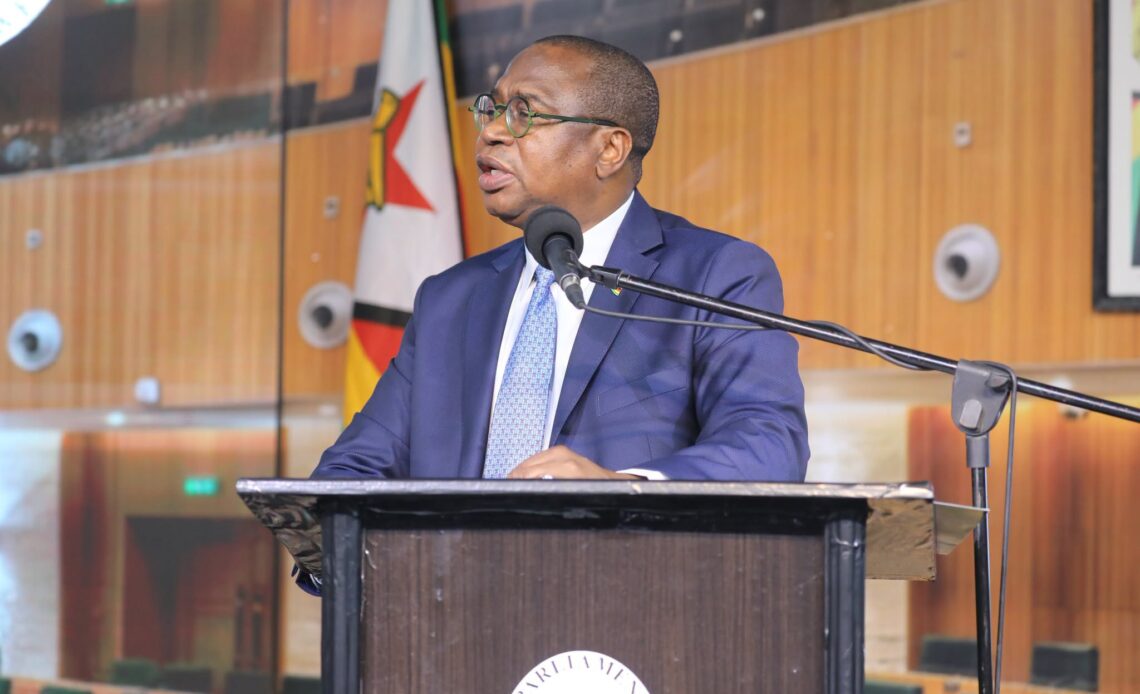
Finance Minister Mthuli Ncube said the government cannot meet the ZiG974 billion budget bids submitted by ministries, departments and agencies (MDAs) for the 2027 National Budget.
Ncube, who is expected to present the proposed 2027 National Budget to Parliament on 19 November 2026, said the bids far exceed the available expenditure ceiling of ZiG347 billion.
Speaking at the 2027 pre-budget seminar in Bulawayo, Ncube said the government could only spend what the economy generates in revenue, emphasising the need to align expenditure with the country’s revenue-collection capacity.
‘’Mr. Speaker, colleagues, let me turn to total bids versus the available budget. Mr. Speaker, sir, during the 2027 national budget consultations with ministries, departments, and agencies, so-called MDAs, a total of 974 billion ZiG was submitted to Treasury as an expenditure bid by these ministries, departments, and agencies.
‘’Mr. Speaker, sir, let me hasten to point out that these bids were submitted at a level way higher than the expenditure ceiling we had set at 347 billion ZiG. How did we get to the expenditure ceiling?
‘’We go through a process. First of all, we come up with what we call a macroeconomic framework, where the first thing we do, we consider what level of GDP was the previous year, and then apply an estimated rate of growth, which is 3.5% for 2027.
‘’Having done that, we then say, well, what’s the size of GDP after that exercise? 66 billion U.S. dollars equivalent. And then, given our current capacity to collect, we typically collect about 18% of revenue as a percentage of GDP.
‘’So 18% of our 66 billion U.S. dollars in dollars, and then converted back into ZiG, that gives us the expenditure ceiling of 347 billion. That’s how we arrived at these numbers. We really go through careful calculations given the capacity of the economy.
‘’So we are unable to meet the entire 974 billion ZiG, but are able to meet what is within the ceiling of 347 billion. That’s what our economy detects,’’ he said.
The Finance Minister also responded to issues and recommendations raised by portfolio committees and ministers during their presentations, including proposals on fuel subsidies, tax thresholds, the Intermediate Money Transfer Tax (IMTT), and funding for the health and education sectors.
Ncube said the government would continue subsidising fuel to cushion consumers in the productive sector against global economic shocks, concurring with a recommendation made by Honourable Lincoln Dhliwayo.
‘’Honourable Lincoln Dhliwayo noted that government should continue subsidising fuel to cushion consumers in the productive sector against global economic shocks. I fully concur we will continue to do so.
The committee also recommended that we increase the tax-free thresholds from 100 U.S. dollars to 150 U.S. dollars to improve disposable incomes and cushion individuals against shocks. We take note of this proposal, and the team is ready to crunch money to see the impact, but we are amenable to this proposal.
‘’I also take note of the committee’s proposal, and other committees as well mentioned this, that we should review the Intermediate Money Transfer Tax (IMTT) downwards in order to further improve the cost, or better reduce the cost of doing business, at least using digital infrastructure. This is also under review.
‘’Mr. Speaker and colleagues, that when it comes to financing the health sector, the education sector, we remain committed to meeting the Dakar Commitment of 20 percent of the national budget towards education and a budget target of 15 percent towards health as recommended by the committee. We’ve really tried hard to adhere to this in the last three to four years.
‘’Let me turn to an issue which the Deputy President of Senate just raised, which is the Constituency Development Fund. Several members also raised it, including the Chief Whip Togarepi. And there’s a proposal to move it to 100,000 U.S. dollars per constituency.
‘’Again, as Treasury we will take a look at this and see if it can be accommodated within the budget envelope. It’s a very important issue, and we want to make sure that we support our members of Parliament in terms of their constituency obligations,’’ he said.
Ncube said the Treasury would also consider proposals to increase the tax-free threshold from US$100 to US$150 to boost disposable incomes and cushion individuals against economic shocks.
The proposed reduction of IMTT was also under review, with the aim of lowering the cost of doing business, particularly through digital financial transactions.
On sectoral allocations, the Finance Minister reaffirmed the government’s commitment to meeting the Dakar Commitment of allocating 20 percent of the national budget to education and the recommended 15 percent to health.
He also said Treasury would assess the proposal to increase the Constituency Development Fund to US$100,000 per constituency, noting that the allocation would have to be accommodated within the available budget envelope.