
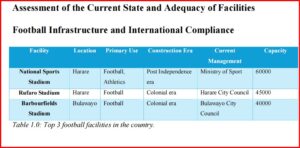
The Portfolio Committee on Sports, Recreation, Arts and Culture’s field visits to football facilities revealed that all the stadiums in the country required upgrades to meet the standards set by the Confederation of African Football (CAF) and FIFA, and currently none of them could host international matches.
Infrastructure deficiency has severely impacted Zimbabwe’s national team, the Warriors, who have been unable to host home matches for AFCON and World Cup qualifiers. Zimbabwe Football Association (ZIFA) informed the Committee that the financial strain was immense, with costs per international window averaging between US$500000.00 and $750000.00. These expenses stem from travel, accommodation, venue rentals, lost ticket sales and local revenue.
For domestic football clubs, the financial burden has been equally overwhelming. Some clubs, such as Dynamos FC, were forced to withdraw from continental competitions in the 2024-25 season due to the prohibitive costs.
National Sports Stadium Renovations
The renovation project at the National Sports Stadium was launched in 2024 in partnership with private sector entities including Sakunda Holdings, with the goal of restoring the venue to CAF and FIFA standards.
When the Committee visited the venue in March 2026, renovations were ongoing, with 100% of bucket seats, which were secured through a donation by Sakunda Holdings, having been installed, all lighting and CCTV installations completed, electronic turnstiles were being installed with three model gates completed and water system upgrades at 75 percent completion.
The Ministry had assured the Committee that by the end of April 2026, some works at the stadium, including pitch installation and water reticulation, would be sorted out and potentially allow the stadium to host the Zimbabwe Warriors’ next international home match.
The Committee had bemoaned the symbolic erosion of national pride caused by the closure of the stadium, recalling the stadium’s legacy as the cradle of Zimbabwean sporting heritage.
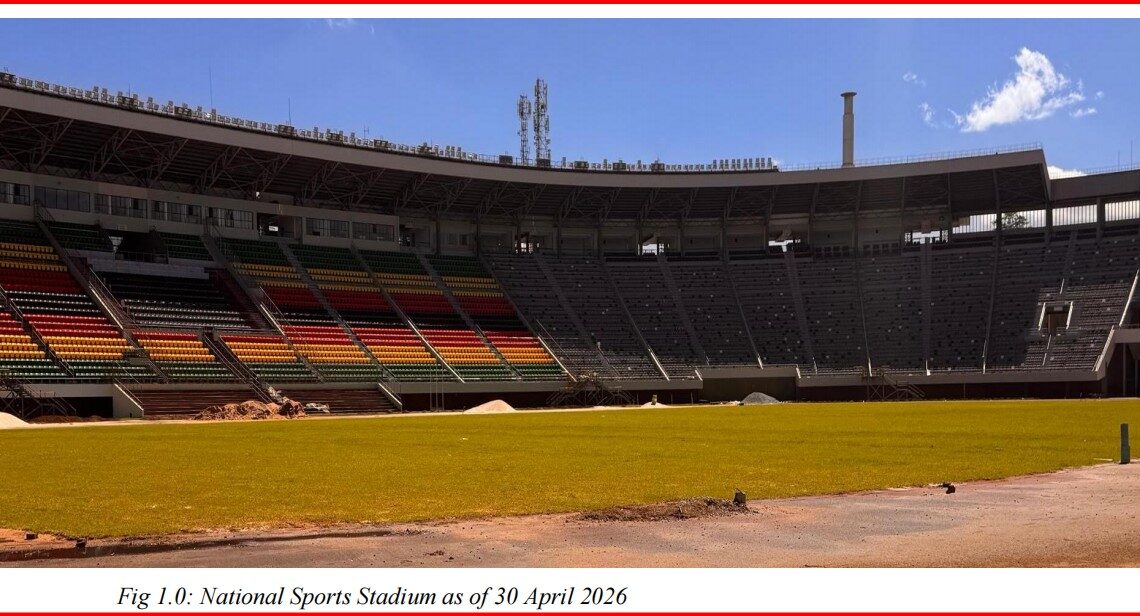
When the Committee visited the stadium on 30th April to assess the estimated target period for pitch installation at the stadium, there had been remarkable progress with 80 percent of the works having been completed.
Key progress updates included turnstiles from Gates 1 to 6 installed and tested, with a dedicated gate for persons with disabilities; demolished toilets were being reconstructed, with tiling and seating nearly complete and partitions being installed; changing rooms were fully rebuilt to CAF standards with all materials delivered; and a new pitch with a functional irrigation system was now in place as shown above.
The Committee showed great appreciation of the significant progress that was made through public private partnerships (PPPs) and funding commitment by the Treasury. In addition to the above, through PPPs being pursued by local authorities, some football venues such as Sakubva, Mandava and Rufaro Stadiums, have had renovation works, with bucket seats, water systems and electrical installations being partly modernised.